 Razzouk Razzouk
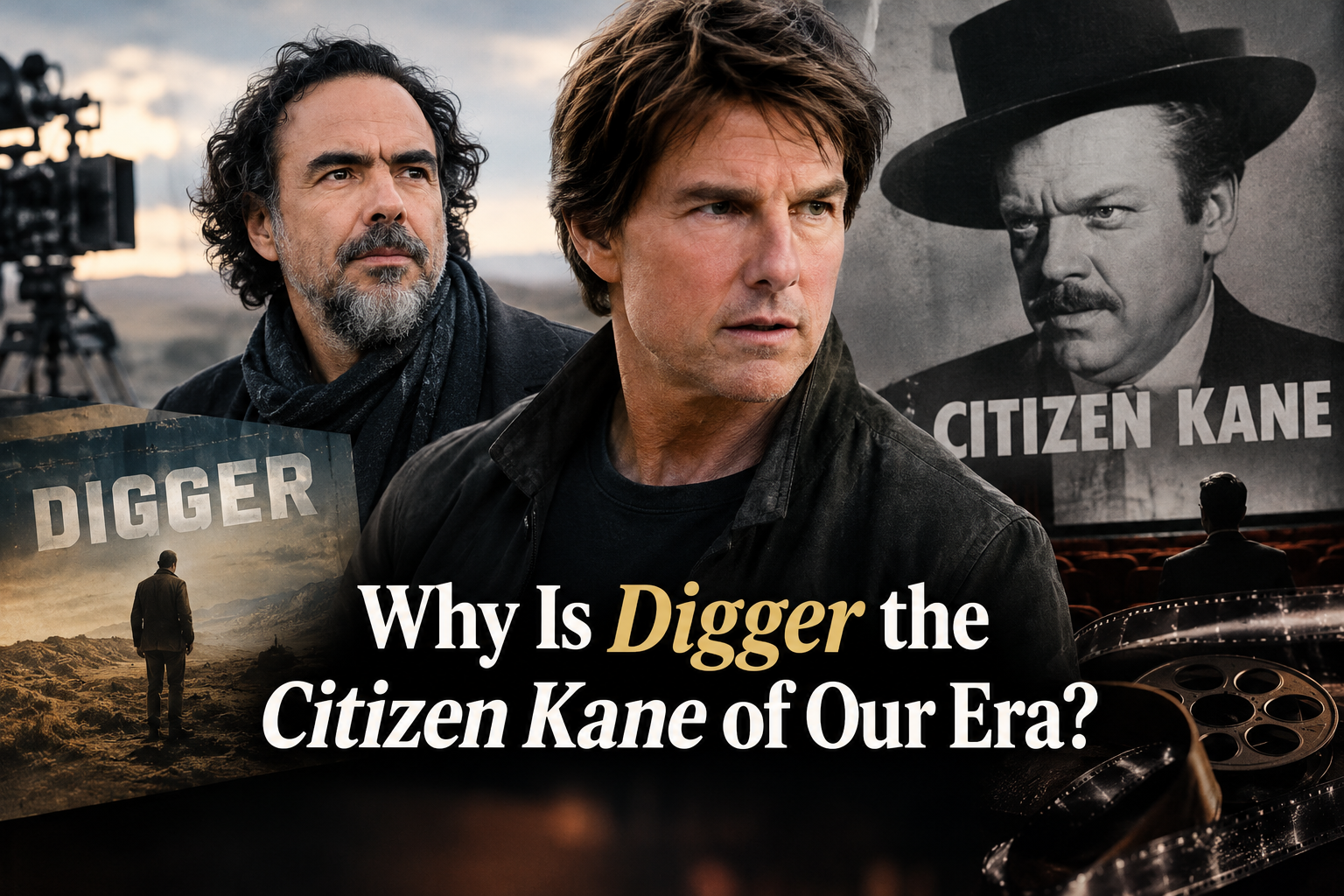
Usually, before writing a review of a movie, I would actually go and watch it. And I will definitely go and watch Digger. But let’s start the process of dissecting why Digger, a movie starring Tom Cruise, who in recent years has mostly chosen big blockbuster projects like the Mission: Impossible franchise or a sequel to Top Gun, suddenly decided to produce and star in a movie that, judging by its title and initial clips, looks more like a passion project than another commercial flick.
This becomes even more evident with the choice of director Alejandro G. Iñárritu, known for unconventional films such as The Revenant, Birdman, 21 Grams, and Babel, to name a few. His films are often ambitious, challenging, and capable of attracting critical acclaim. The cast of Digger also brings together raw talent, including Jesse Plemons, and legendary performers such as John Goodman.
On paper, this looks like a recipe for success, both critically and at the box office. Yet, for some reason, I believe the movie was destined to struggle commercially.
Well, my friends, there is something important you need to know: this kind of movie, this kind of story, and the way it appears to have been approached are, in my view, refreshingly original. It is not a remake or an adaptation of some European story or Asian flick. It is an original story.
I will quote a friend of mine, a Lebanese film critic whom I believe has real merit because he reviews movies without the apparent expectation of getting something in return. My friend Anis Tabet, whose Instagram page you should follow at @tlkabtmovies, put it simply: “Love or hate it, it’s original.”
For more than 40 years, Hollywood has increasingly built an industry around repeating successful formulas, recycling familiar stories, and remaking existing films. And here come Iñárritu and Cruise with their inconveniently original story, reminding us that cinema can still take risks.
After decades of familiar formulas, audiences have become accustomed to knowing what they are going to get. Many simply want to relax and watch another Fast & Furious sequel, whether number 10 or 11, or another Star Wars movie that struggles to measure up to the original trilogy. Even The Departed, one of my favourite Martin Scorsese films, is a remake of the Hong Kong movie Infernal Affairs. And the list goes on.
So, why is Digger the Citizen Kane of our era?
The straightforward answer is that, although the two films tell entirely different stories, both represent the ambitions of talented filmmakers working with talented performers to deliver something original. The comparison is not about claiming that the two movies are equal in artistic achievement. Rather, it is about their ambitions, their relationship with the world around them, and the possibility that a film can be misunderstood or underappreciated by its contemporary audience.
Orson Welles introduced filmmaking techniques in Citizen Kane that are still studied in film schools and continue to inspire storytellers and filmmakers. Its artistic legacy eventually became far greater than its initial commercial success.
There is another interesting parallel worth considering: the historical circumstances surrounding their releases.
Citizen Kane premiered in 1941, during the Second World War, one of the most devastating conflicts in human history. Propaganda was being used extensively, and political and economic interests influenced the media landscape. The film also faced controversy surrounding its portrayal of a powerful media magnate, William Randolph Hearst, who reportedly used his influence against it.
Now consider Digger, a film whose apparent approach is cynical toward the rich and powerful. In a world marked by uncertainty, political tension, and enormous concentrations of wealth and influence, such a project may be an uncomfortable proposition.
Could that discomfort help explain why an unconventional film struggles to find its audience? Perhaps. Could the commercial system itself be part of the problem, favouring familiar franchises over original ideas? Absolutely worth discussing.
But I would be careful about claiming that powerful people deliberately caused a film to fail without evidence. The more interesting question is whether a system dominated by commercial interests gives genuinely original films a fair chance in the first place.
Perhaps that is where the comparison with Citizen Kane becomes most compelling. Both invite us to consider the relationship between cinema, power, artistic ambition, and commercial success.
Maybe the problem is not that audiences hate originality. Maybe, after years of being offered familiar stories, audiences have simply been conditioned to expect them.
And perhaps the real irony is that Hollywood, an industry built on storytelling, can sometimes appear more comfortable telling the same story over and over again than taking the risk of telling a new one.


 Razouk²


